
A review of Yusuf Bodiat’s The Bottom Line.
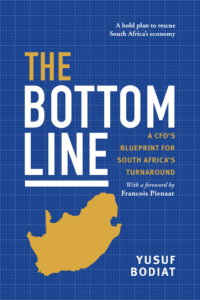
Yusuf Bodiat’s The Bottom Line asks a question that most South African policy writing tiptoes around: why does a state rich in talent and natural resources, with the formal architecture of a functioning country – constitution, treasury, reserve bank, courts, statistical agency – struggle so visibly to deliver the things states are supposed to deliver?
Part of his answer is that we have a finance and execution problem. Departments spend their budgets in the wrong half of the year. Suppliers go unpaid for 60 to 120 days. Mid-year revenue shortfalls trigger spending halts even on critical services. Conditional grants arrive in tranches that don’t match operational tempo. State-owned enterprises and government departments owe each other money in circular webs that paralyse cash flow. None of this is high political drama. It’s the kind of dysfunction a CFO sees when they walk into a struggling company on day one.
This is one of the book’s real strengths. Bodiat is quite specific about mechanisms, which given his background as a CA and CFO should surprise no-one. Most commentary on the South African state stops at “corruption” or “incompetence” and treats those as explanations rather than as labels for things that need explaining. Bodiat goes a layer deeper. He names the procurement calendar, the in-year reallocation, the supplier payment cycle, the conditional grant framework, the inter-entity liability tangle. These are the operational chokepoints where good intentions die, and they’re invisible to most political analysis because they live in the cash flow weeds where only finance people spend time.
I’d recommend this book to anyone who wants to understand how the state actually fails, day to day. I’d also recommend it to a wider audience the author may not have had specifically in mind: aspiring CFOs, finance managers, and non-executive directors looking for a worked example of how a serious and strategic accountant approaches a system in distress. The lessons and case studies transfer. It may be particularly helpful to consider a setting outside of your own company or industry to take home the principles rather than the specific applications.
Where the lens helps
The book’s strongest moments are the operational ones. The taxi industry case study is honest about how vested interests entrench themselves in the status quo. The discussion of payment delays correctly identifies that small suppliers price in risk or stop bidding altogether, which narrows the supplier base and raises costs in ways that don’t show up on any single department’s books. The treatment of inter-governmental debt – PRASA waiting on departments, Eskom waiting on municipalities, water boards waiting on everyone – is the kind of insight that comes from practical experience of managing cash flow rather than just reading about it.
The case studies of Botswana, Greece, Indonesia, India and the SARS rebuild under Edward Kieswetter are thought-provoking, and Bodiat draws useful lessons from each. The Kieswetter story in particular is a useful counterweight to pure pessimism: institutions can be rebuilt, and the SARS muscle that was hollowed out during the Moyane years has substantially returned. It took a specific person, political cover, and time, but it happened.
Bodiat is also strong on the gap between plans and execution, which he treats as a separate discipline rather than as something that follows automatically from a good document. His National Development Plan case study is a good example: the NDP was not formally costed, lacked binding commitments from departments, came with no dedicated funding lines, and got absorbed into other planning instruments without strong alignment or ownership. Coordination was weak, accountability was unclear, and progress was hard to measure. He’s right that this is the more interesting failure than the headline failure to hit the targets – the NDP didn’t fail because the targets were wrong, it failed because the machinery to deliver them was never assembled. A CFO, he argues, doesn’t only look at where the business wants to go; they ask what resources, systems, and capacity are needed to get there, and they follow up relentlessly. That mindset, applied to public planning, would change the relationship between plans and outcomes.
The book is also right that we have a measurement and consequence problem. Ministers in South Africa rarely lose their jobs because their underlying portfolios are performing poorly. They lose them through criminal proceedings or factional politics. The performance of the state, in any meaningful operational sense, is barely measured and barely reported. Bodiat’s point is that performance management without consequence becomes compliance theatre: plans are signed off, boxes are ticked, and very little changes. Promotions are based on seniority rather than delivery. Underperformance becomes the norm rather than the exception, and the people who suffer most are those who are still trying to do their jobs properly. The call for performance dashboards isn’t sufficient on its own – measurement alone never is – but coupled with real consequence, it would at least begin the conversations we can’t currently have.
Questions the book opens up
Reading carefully, I found myself wanting to follow several threads further than the book takes them. Some of these are probably beyond its intended scope, but they’re worth naming because they’re the most interesting questions the book provoked for me.
The first thread is why the operational dysfunctions Bodiat diagnoses so well are so persistent. Late payments create discretion over who gets paid first. Conditional grants create national-over-provincial control. Front-loaded spending creates patronage windows. Circular debt creates leverage. The political economy literature – Brian Levy on South Africa specifically, Lant Pritchett and Matt Andrews on state capability more generally – argues that these patterns persist because they serve someone, and that institutional reform has to engage with the political settlement that produces them. Bodiat invokes “political will” briefly on page 45, which I read as the moment the framework acknowledges that something underneath it matters. I’d love to see him write more about that layer in future work, because his operational lens combined with serious engagement with political economy would be valuable.
The second thread is the size of the personal income tax base. Bodiat correctly notes that only around seven million South Africans pay personal income tax out of roughly forty million adults. But of those forty million, only sixteen or seventeen million are employed at all – unemployment is 30%+ on the narrow definition and over 40% on the expanded definition that includes discouraged workers. The South African personal income tax threshold is also high relative to the income distribution by design, so the bottom half of earners pay no PIT as a matter of policy. The “small tax base” is therefore as much a labour market story as a tax administration story. Bodiat’s point about the benefits of formalisation is well-taken; I’d add that the binding constraint may sit further upstream, in why people remain in the informal sector in the first place – minimum wages, skills mismatches, transport costs, apartheid-era spatial planning. Different problem, different toolkit.
The third thread is one I think extends Bodiat’s own balance-sheet thinking in a useful direction. The book discusses debt-to-GDP, which is the standard sovereign metric, but a stock-to-flow comparison that focuses only on liabilities. For South Africa, the asset side of the public balance sheet has deteriorated faster than the debt side has grown. Eskom, Transnet, SAA, Denel, the Post Office – assets that were once meaningful have become contingent liabilities that crystallise on the sovereign balance sheet through bailouts and guarantees. Sovereign net worth has fallen by far more than headline debt-to-GDP suggests. The IMF publishes consolidated public sector balance sheet data for some countries; on that basis the picture is materially worse than the standard headline number. This is exactly the kind of analysis Bodiat’s lens is well-suited to, and a natural extension of the diagnostic frame the book establishes.
The fourth thread is one I’d like to see the framework engage with more deeply: not just the level of public debt, but its composition. Two questions matter as much as the headline number. First, who holds the debt? Most South African government debt is rand-denominated and held domestically, largely by pension funds, banks and insurers. That is materially different from foreign-currency debt held by external creditors – there is no currency mismatch and no foreign coordination problem on restructuring – but it is also not without consequence. Domestic debt is a contingent intergenerational transfer with a specific distributional incidence. The people who hold the bonds (older, wealthier, institutional, including pension funds) are not the same people who pay the taxes that service them (younger, working, broader base). In an unequal society, the comforting “we owe it to ourselves” framing hides which “we” owes which “we”. Second, what is the relationship between the real interest rate on debt and the growth rate of the economy? When growth exceeds the real interest rate, debt dynamics are stable even at high levels and well-directed borrowing can be self-financing through future revenues. When the relationship inverts, even modest debt becomes a compounding problem. Both questions sit naturally inside Bodiat’s balance-sheet framing and would, I think, sharpen it. They also touch on territory that Paul Krugman’s A Country Is Not a Company covers well, on why firm-level intuitions about debt break in specific places at national scale.
What I’d have liked more of
Two of Bodiat’s seven priorities for fixing South Africa are education and infrastructure. I think both deserve even more space than they get.
The PIRLS 2021 reading assessment found that 81% of South African Grade 4 learners couldn’t read for meaning in any language – the worst result among participating countries. Matric pass rates have become a textbook case of Goodhart’s Law: when a measure becomes a target, it ceases to be a good measure. Standards have dropped, the 30% pass mark for some subjects is normalised, weak learners are pushed out before matric to flatter the denominator. A current debate about whether to retain Maths Literacy as an alternative to Maths illustrates the same trap: defenders argue that removing it would reduce matric pass rates, as though the matric certificate were the goal rather than a proxy for the underlying competence it is meant to certify. Optimising the proxy at the expense of the substance is how a measurement system stops measuring anything useful.
Education is fundamental to labour force participation, labour productivity, upward social mobility, a sense of optimism and possibility, and economic growth itself. It’s the production function for the next generation of workers, taxpayers, voters and citizens, and it deserves more time in the book.
Infrastructure deserves a similar centrality, particularly transport. Rail and ports are not just government services to be delivered efficiently; they are the multipliers that determine whether the economy grows at all. Public transport, even when it runs at an accounting loss, generates returns through reduced congestion, lower emissions, and labour market access that the firm-style P&L doesn’t capture. This is where the public goods and externalities framing matters most, and where I’d push Bodiat’s framework toward economics-style thinking on positive externalities and crowding-in of private investment.
The verdict
The Bottom Line is a useful book by someone who has thought carefully about how the state fails operationally and who has tools that genuinely apply at that layer. The diagnosis of cash flow dysfunction is specific where most commentary is vague. It sits within a wider case for governance discipline, consequence management, and integrity, and the argument is hard to disagree with: institutions which tolerate poor performance produce it, controls without consequences are theatre, and integrity is the load-bearing element on which the rest depends. The case studies are engaging. The proposed mechanisms – performance dashboards, payment discipline, supplier protections, citizen trust as a flywheel – would all help if implemented.
If there were more Yusuf Bodiats in every department of the South African state, we would be in materially better shape. The fact that we don’t have them, and don’t seem able to put them in place even when we know who they are, is a question the book opens up rather than closes – and that’s a useful contribution on its own. Books that close questions stop conversations. Books that open them well, as this one does, start them.
I’d recommend it to anyone wanting to understand the operational layer of the South African state. I’d recommend it equally to young CAs, aspiring CFOs, and non-executive directors who want to see a serious finance mind at work on a problem larger than any single company.
You can order the book from Exclusive Books or Yusuf’s own site.




Leave a Reply